What Is Saju? Korean Four Pillars and the Eight Characters
Heo Yu (Kim Dong-hyun) · Updated 2026.11.10 · 6 min read
Saju (사주) is the Korean name for the Four Pillars of Destiny (BaZi): eight characters from your birth year, month, day and hour, and how to read them.
This article is translated from the Korean original. Read the Korean original
Contents ⌄
Saju (사주, 四柱) is the Korean name for the Four Pillars of Destiny, known in Chinese as BaZi. Your birth year, month, day and hour each become a pillar, and each pillar holds two characters. Four pillars make the saju and eight characters make the palja, so Koreans often call the whole chart saju palja. Heo Yu reads these eight characters not as a cage for your fate but as the outline of your own life's script.
Four pillars and eight characters
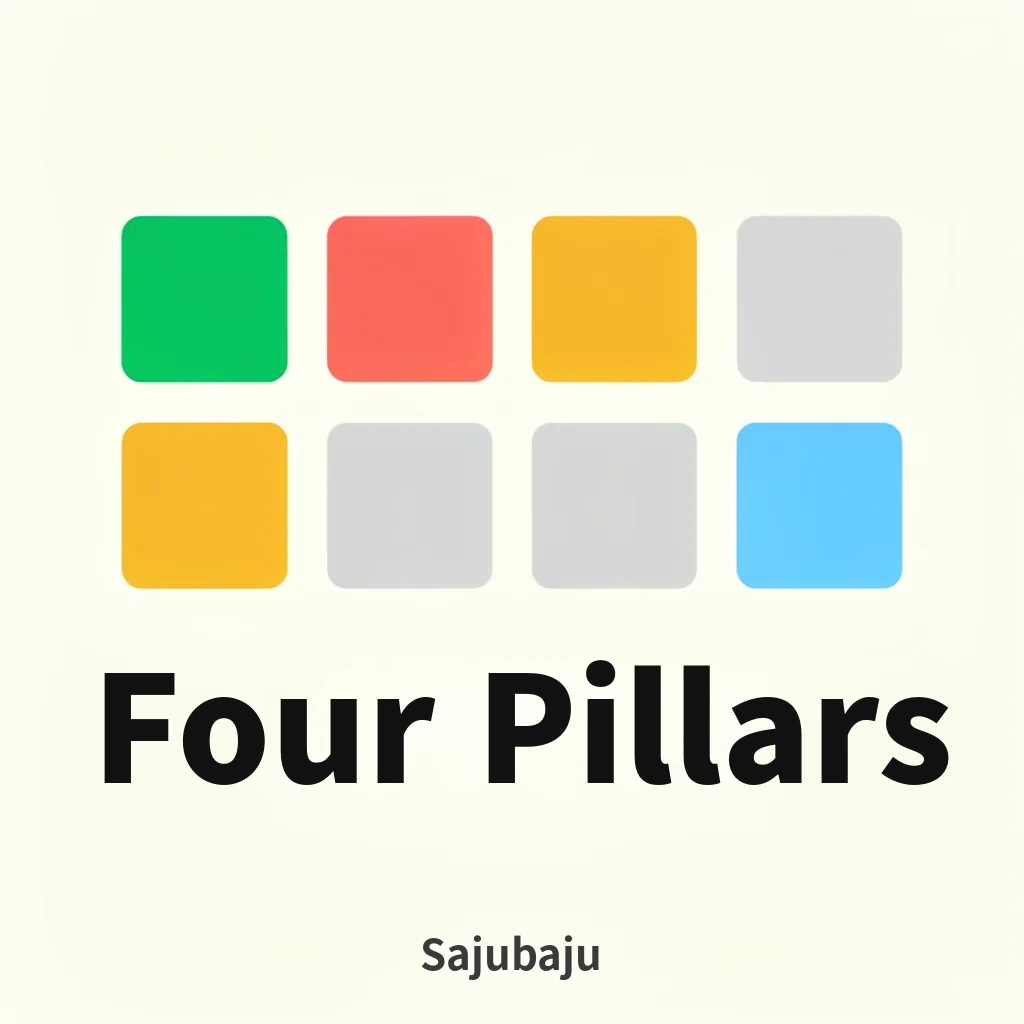
The four pillars are the Year Pillar, Month Pillar, Day Pillar and Hour Pillar. The Year Pillar stands for the year you were born, the Month Pillar for the month, the Day Pillar for the day and the Hour Pillar for the time of birth. Each pillar has a top and a bottom character, which is why pillars carry two-character names such as Jia Zi (甲子, Gapja in Korean) or Bing Wu (丙午).
The top slot holds a Heavenly Stem. There are ten stems: Jia, Yi, Bing, Ding, Wu, Ji, Geng, Xin, Ren and Gui (甲乙丙丁戊己庚辛壬癸). The bottom slot holds an Earthly Branch, and twelve branches rotate in order: Zi, Chou, Yin, Mao, Chen, Si, Wu, Wei, Shen, You, Xu and Hai (子丑寅卯辰巳午未申酉戌亥). Pairing ten stems with twelve branches gives sixty combinations, the sixty-pillar cycle (the 60 Jiazi). Each of your four pillars is one of these sixty.
Heo Yu gives the two rows different jobs. The stems are the blueprint of the mind; the branches are outer reality. The four characters on top show your thoughts and psychology, and the four below show the environment and circumstances you live in.
Korean manseryeok apps (the perpetual calendars used to build a chart) usually place the Year Pillar on the far right and run the Month, Day and Hour Pillars toward the left. Some apps start from the left instead, so check the pillar labels above the table first.
Four pillars (saju) × two characters = eight characters (palja). The year, month, day and hour each get one Heavenly Stem and one Earthly Branch.
How each pillar is set
In saju, the year and month do not turn over on January 1 or on the 1st of each month; they follow the solar terms, so the same date can fall into a different pillar depending on which solar term it sits in.
- Year Pillar: it changes at Lichun (Start of Spring), not on January 1 or Lunar New Year. Lichun falls around February 4 each year. If you were born in January, or in February before Lichun, you take the previous year's pillar. Your zodiac animal also comes from the branch of this Year Pillar.
- Month Pillar: it changes at the solar term that opens each month, not on the 1st. From Lichun until Jingzhe (Awakening of Insects) is the Yin (寅) month, and from Jingzhe until Qingming is the Mao (卯) month. The branch for each month is the same every year; the stem changes with the year's stem.
- Day Pillar: the sixty pillars run one per day without a break. If you know the date, you can look up that day's pillar directly.
- Hour Pillar: the day is split into twelve two-hour blocks, each given a branch. Korean Standard Time differs from the actual movement of the sun by about 30 minutes, so some manseryeok apps correct for this before setting the Hour Pillar.
All of these rules come from the seasons. Heo Yu sees the parts of saju, such as the Month Command, the 24 solar terms, the hidden stems and the growth, peak and storage branches (the branches that open, peak and close each season), as the result of dividing the seasons into ever finer units. The year is cut at Lichun, the month at the solar terms, and the day and hour are finer cuts still. A saju chart is a set of coordinates in finely divided seasonal time.
What each pillar shows
Each of the eight positions has a name: year stem and year branch, month stem and month branch, day stem and day branch, hour stem and hour branch. The table sums up what Heo Yu reads in each position.
| Pillar | Stem position | Branch position | Based on | What Heo Yu reads |
|---|---|---|---|---|
| Year | Year stem | Year branch | Birth year (from Lichun) | Year branch: the demands and expectations of the people around you, given at birth |
| Month | Month stem | Month branch | Birth month (by solar term) | Month branch: the backdrop of the stage you were born onto, your environment |
| Day | Day stem | Day branch | Birth day | Day stem: your own mind and thinking / Day branch: relationships and the direction you choose for yourself |
| Hour | Hour stem | Hour branch | Birth time (two-hour blocks) | Hour branch: your private sphere and the results that build up over a life |
The reference point among the eight characters is the day stem, called the Day Master. The Day Master is "you" in the chart, and the other seven characters are read by their relationship to it.
The first character Heo Yu checks is the month branch. It tells you the backdrop of the stage you were born onto, so it is the reference for finding the chart's structure (geokguk, 格局) and for counting the Luck Pillars. Heo Yu says to read the environment from the month branch and the inner self from the Day Master, and never mix the two.
The year branch and day branch are seen as positions that rarely change once set. The month branch and hour branch are read as conditions and results of the environment, whose influence shifts as experience builds up. That is why the same character tells a different story depending on which pillar it sits in.
How to read your own chart with a manseryeok
You can work out the eight characters by hand, but matching the exact time of each solar term is easier with a manseryeok (perpetual calendar). The steps are simple.
- Enter your date of birth. A lunar birthday works too; the calendar converts it to the solar calendar and then calculates by solar term.
- Enter your time and place of birth. If you don't know the time, the chart can be read with six characters, leaving out the Hour Pillar.
- Check the eight characters on the chart. The top four are stems; the bottom four are branches.
- Find the top character of the Day Pillar, the Day Master, first. Then find the bottom character of the Month Pillar, the month branch.
For example, someone born at noon on November 3, 2026 has Bing Wu (丙午) year, Wu Xu (戊戌) month, Xin Si (辛巳) day and Jia Wu (甲午) hour. Lidong (Start of Winter) has not arrived yet, so the month is still the Xu (戌) month. This person's Day Master is Xin (辛) and the month branch is Xu (戌). Xu is the last of the three autumn months, so this person was born onto a stage that closes the autumn.
A free manseryeok will show you the same eight characters. Building the pillars follows fixed rules, so paying for a reading does not change the characters. Calendars do differ in where they draw the line between days and how they correct the time, though, so the Hour Pillar can change. If you were born around midnight, or on the day of Lichun or another solar term, check those settings once more.
Is saju a fixed destiny?
Many people hear "saju" and think of a fate that cannot be changed. The script outline Heo Yu describes says what kind of stage the main character stands on, what abilities they hold and what events they meet. It does not say how the story ends.
Heo Yu's casting goes like this. The month branch is the stage the main character is born onto. The structure and the Useful God are the abilities in the character's hands, the Luck Pillars are the order in which the story unfolds, and the annual pillars are the events that arrive each year.
Two people can receive the same eight characters and still make different choices on that stage. That is why Heo Yu uses saju as a map for understanding yourself rather than as fortune-telling.
Frequently asked questions
What is saju?
Saju is the Korean name for the Four Pillars of Destiny. Your birth year, month, day and hour become the Year, Month, Day and Hour Pillars, and each pillar holds a Heavenly Stem and an Earthly Branch, eight characters in all. Four pillars are the saju; the eight characters are the palja.
Where do I start reading a saju chart?
Find the top character of the Day Pillar, the Day Master, first. The Day Master is you in the chart. Then look at the bottom character of the Month Pillar, the month branch, to read the environment you were born into, the backdrop of your stage.
Can I get my saju chart for free?
Yes. Enter your date and time of birth into a free manseryeok and you can check the eight characters yourself. Building the pillars follows fixed rules; only the Hour Pillar may differ depending on the time-correction setting.
Can I read my saju without knowing my birth time?
Yes, with the six characters of the Year, Month and Day Pillars. The Day Master and the month branch are both among these six, so the basic structure still reads clearly. The private sphere and results read from the hour branch are left blank.
Why does a January birthday use the previous year?
Because the saju year changes at Lichun, not on January 1. Lichun falls around February 4, so anyone born in January, or in February before Lichun, takes the previous year's Year Pillar. If you were born on the day of Lichun, check the exact time with a manseryeok.