Peach Blossom Star in Saju: How to Find It and What It Means
Heo Yu (Kim Dong-hyun) · Updated 2026.11.10 · 8 min read
How to find the Peach Blossom star in your saju chart from your year or day branch, what two Peach Blossoms mean, and why it signals charm, not infidelity.
This article is translated from the Korean original. Read the Korean original
Contents ⌄
The Peach Blossom star (dohwa-sal, 桃花煞) is one of the twelve symbolic stars of saju, set by the Three Harmonies group that your year branch or day branch belongs to. Of the four branches Zi, Wu, Mao and You (子午卯酉), the one that pairs with that group is your Peach Blossom; if it appears in another branch of your chart, you have the star. In the twelve-star table, the same star is also called Nyeon-sal (年煞). Heo Yu reads the Peach Blossom not as a sign of infidelity but as an asset: charm, expressiveness and the ability to connect with people.
How to find your Peach Blossom
You find the Peach Blossom with the Three Harmonies. First, see which Three Harmonies group your year branch, the branch of your birth year, belongs to. Pick that group's Peach Blossom branch from the table below, then check whether it appears in your month, day or hour branch. Repeat the same steps using your day branch as the base, and you're done.
| Base branch (year or day) | Three Harmonies group | Peach Blossom branch | Season of the Peach Blossom |
|---|---|---|---|
| Shen 申 · Zi 子 · Chen 辰 | Shen-Zi-Chen | You 酉 | Autumn |
| Yin 寅 · Wu 午 · Xu 戌 | Yin-Wu-Xu | Mao 卯 | Spring |
| Si 巳 · You 酉 · Chou 丑 | Si-You-Chou | Wu 午 | Summer |
| Hai 亥 · Mao 卯 · Wei 未 | Hai-Mao-Wei | Zi 子 | Winter |
For example, someone born in 1990 was born in a Geng Wu (庚午) year, so the year branch is Wu (午). Wu belongs to Yin-Wu-Xu, so the Peach Blossom branch is Mao (卯). If Mao appears in this person's month, day or hour branch, they have a year-based Peach Blossom. If you were born in January or February before Lichun (Start of Spring), use the previous year's branch; if you're unsure of your year branch, check it with a manseryeok (Korean perpetual calendar) first.
Having Zi, Wu, Mao or You in your chart does not always mean a Peach Blossom. Only the one branch that pairs with your base group counts. The Peach Blossom branch always belongs to the Three Harmonies group just before the base group, so it never falls on the base position itself. With the year branch as the base, the year branch never carries the star; with the day branch as the base, the day branch never does.
In the common view, the Peach Blossom position is explained as the Bath (沐浴) stage of the 12 Life Stages for the element that the Three Harmonies group forms. In the Shen-Zi-Chen Water frame, You is the Bath stage; in the Yin-Wu-Xu Fire frame, Mao is. Old texts also called the same star Xian Chi (咸池).
Finding the Peach Blossom: Three Harmonies group → branch
- 申 子 辰Shen-Zi-Chen酉You
- 寅 午 戌Yin-Wu-Xu卯Mao
- 巳 酉 丑Si-You-Chou午Wu
- 亥 卯 未Hai-Mao-Wei子Zi
The Peach Blossom sits at the Nyeon-sal (年煞) position in the twelve-star table. You find it from the Three Harmonies group of your year or day branch, and it is always one of Zi, Wu, Mao or You (子午卯酉).
Two Peach Blossoms: year-based and day-based
"Two Peach Blossoms" usually means one of two cases. One is finding a Peach Blossom from both the year branch and the day branch. The other is the same Peach Blossom branch appearing in two positions, such as the month branch and the hour branch.
Heo Yu weighs the two bases differently. The year base stands for demands and expectations that the people around you hand you first, without your asking. The day base stands for the direction in life you want for yourself. So a year-based Peach Blossom shows up as others finding your charm first and expecting things of you, while a day-based Peach Blossom shows up as your own wish to express yourself and widen your circle.
In the common view, the more Peach Blossoms you have, the stronger the tendency. Heo Yu's reading of the symbolic stars looks first at which base and which position a star sits in, rather than counting them. Even with two, a year-based Peach Blossom in the month branch and a day-based one in the hour branch play out on different stages.
Is the Peach Blossom an unlucky star?
In older saju practice, the Peach Blossom was a star to be wary of. It went by names like Six Losses (六敗) and Xian Chi, and was often tied to romantic trouble or family discord. Many readings stressed the gossip that follows charm.
Heo Yu sees those readings as products of the conditions of older societies. In farming societies that prized chastity and restraint, eye-catching charm was more of a danger than an advantage. Heo Yu speculates that warnings meant to protect attractive people and prevent abductions hardened into the reading that "the Peach Blossom is unlucky."
Today individuality and self-expression are a competitive edge. In an age of personal branding and social media, the power to draw people in is no longer a danger to avoid but a talent to use. That is why Heo Yu reads the Peach Blossom as an asset for connection rather than a moral risk. The ability to express feelings with care and understand others deeply is an essential people skill today.
Traits of a chart with the Peach Blossom
Ask about the traits of someone with the Peach Blossom and most people think of looks first. Having the star does not determine your looks. Heo Yu reads it on three layers: the growth-peak-storage cycle, how the star works, and the seasons.
- Peak branch: leading self-expression. Zi, Wu, Mao and You are peak branches, where a season reaches its height. The star shows up as the drive to put your own personality and presence forward.
- Cause and effect: accumulated people skills. The Peach Blossom is where the previous Three Harmonies group is at work. What you went through in past relationships builds up into your charm today. Heo Yu reads this cause and effect not as karma but as causes and results within your environment.
- The previous season: past experience as a footing. Tasks carried over from the past affect the present. When you build on past experience and move beyond it, the star becomes a deeper charm than looks, and the ability to form lasting relationships.
Put the three layers together and the Peach Blossom is a power that shows between people. It is the ability to read others' feelings quickly and offer the right comfort or encouragement. It is closer to seasoned skill born of experience than to natural flair.
Peach Blossom by position
Where the star sits, and from which base, changes the area of life it shows in. Here is Heo Yu's reading by position, centered on cases where the base branch is a growth branch.
| Position | Year-based | Day-based |
|---|---|---|
| Peach Blossom in the year branch | Not possible (base position) | Natural flair and a pleasant presence, a charm that is hard to explain |
| Peach Blossom in the month branch | Charm becomes part of your identity in the environment you grew up in | Trial and error while building your own brand |
| Peach Blossom in the day branch | Using charm strategically to lead in relationships | Not possible (base position) |
| Peach Blossom in the hour branch | An artistic, romantic side in private life | Rich emotional expression and artistic sense in daily life |
A Peach Blossom in the day branch means the Peach Blossom branch, counted from the year branch, sits in your day branch. The day branch is the place of the relationships and life you choose, so you stand out for using your charm actively in close relationships. If the base branch is a peak branch, it shows up as a leader who is both trusted and loved.
A Peach Blossom in the month branch also varies by base. If the base branch is a peak branch, self-expression can go too far and cause friction; if it is a storage branch, you may feel frustrated when people around you miss your deeper thinking. Neither is a verdict. Take each position as its own task.
Three kinds of charm
The same Peach Blossom splits into different kinds of charm depending on whether the base branch (year or day) is a growth, peak or storage branch. It makes more sense to read these kinds separately than to lump everything under "flirtatious."
- Charm of change: when the base branch is a growth branch, Yin, Shen, Si or Hai, the position of the Ji-sal (地殺, Earth) star. A taste for the new joins with charm to create a distinctive presence.
- Leader's charm: when the base branch is a peak branch, Zi, Wu, Mao or You, the position of the Jangseong-sal (將星, General) star. Charisma and warm humanity go together, earning both trust and affection.
- Reflective charm: when the base branch is a storage branch, Chen, Xu, Chou or Wei, the position of the Hwagae-sal (華蓋, Canopy) star. An intellectual yet emotional personality that forms deep bonds with a few people.
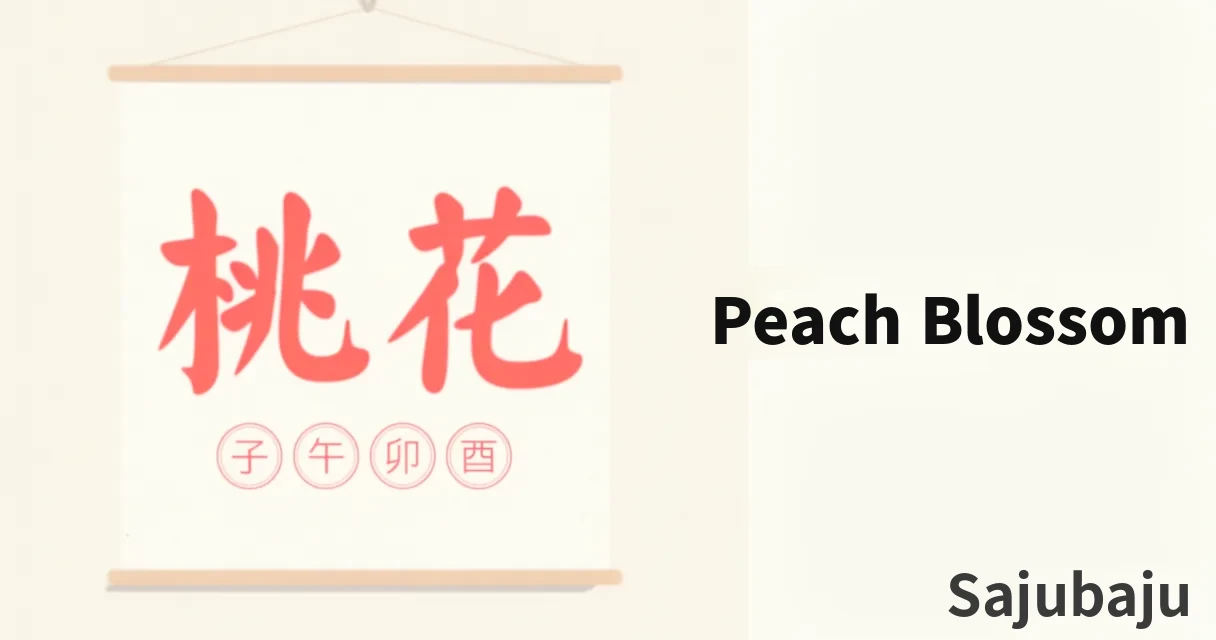
Peach Blossom in love and work
With the Peach Blossom, you tend to take the lead and be proactive in love. Past trial and error turns into a mature sense of romance; you notice your partner's changing feelings quickly and care for them warmly. In marriage, too, you check your spouse's mood first and work to hold the family together.
There are things to watch. Habits from past relationships can carry into the present without your noticing, and striking charm can invite unexpected misunderstandings or a partner's jealousy. Setting clear boundaries in each relationship and stating your intentions openly cuts down on misunderstandings.
For work, fields where leading self-expression and accumulated people skills are strengths suit you well.
- Creative and expressive work: writer, director, designer, marketer, content director, influencer
- People-facing services: sales, account management, counseling, hotel staff, flight attendant, brand manager
- Education and coaching: teacher, counselor, coach
- Digital fields: UX/UI designer, community manager, digital marketer
Don't lean on charm alone, though; build expertise and skills alongside it. When you keep your sincerity, charm deepens with time.
How to make good use of the Peach Blossom
The task of the Peach Blossom is not to suppress it but to grow it in the right direction. Heo Yu recommends four things.
- Don't shrink back because of past misunderstandings or hurt. Trust that your charm comes from sincerity.
- Keep the right distance for each kind of relationship, and make your intentions clear.
- Fill yourself with reading, art and expertise. It is how you beat the temptation to rely on looks alone.
- Get feedback from a mentor or friend you trust, and use your charm to be a good influence rather than to draw attention.
Keep these four, and the Peach Blossom becomes a lasting asset for connection.
Frequently asked questions
Does the Peach Blossom mean someone will cheat?
You can't conclude that. The infidelity reading came from older societies that were wary of charm. Heo Yu sees the Peach Blossom as charm, expressiveness and people skills that show as experience builds up.
How do I find the Peach Blossom in my saju chart?
Use the Three Harmonies group of your year branch or day branch. For Shen-Zi-Chen it is You, for Yin-Wu-Xu it is Mao, for Si-You-Chou it is Wu, and for Hai-Mao-Wei it is Zi. If that branch appears elsewhere in your chart, you have the Peach Blossom.
Is every Zi, Wu, Mao or You a Peach Blossom?
No. Only the one branch that pairs with your base group counts. For someone whose year branch is Wu (午), Zi is not the Peach Blossom; Mao is.
Are two Peach Blossoms stronger?
The common view says more Peach Blossoms make the tendency stronger. Heo Yu looks at base and position before the count. A year-based Peach Blossom shows as others' expectations, and a day-based one as the expression you want for yourself.
What does a Peach Blossom in the day branch mean?
It means the Peach Blossom branch, counted from the year branch, sits in your day branch. The day branch is the place of the relationships and life you choose, so it shows as using your charm actively in close relationships. Counted from the day branch itself, the day branch can never be the Peach Blossom.
Is the Peach Blossom the same as the Red Romance star?
No, they are different stars. The Peach Blossom is one of the twelve symbolic stars found from the Three Harmonies of the year or day branch, while Red Romance (紅艶, hongyeom-sal) is said to be found from the Day Master.