Gui Wei (癸未) Day Pillar: Personality, Love & Career
Heo Yu (Kim Dong-hyun) · Updated 2026.11.21 · 8 min read
Gui Wei (癸未), 20th of the 60 day pillars: Yin Water over Earth, a Seven Killings in the spouse palace and Mu (Tomb). Personality, love and careers.
This article is translated from the Korean original. Read the Korean original
Contents ⌄
Gui Wei day pillar at a glance
The Gui Wei (癸未, Gyemi in Korean) day pillar is the 20th of the 60 pillars. It pairs the Heavenly Stem Gui Water (癸水, yin Water) with the Earthly Branch Wei Earth (未土). On the basis of delicate intuition and steadiness, it has a careful, analytical tendency and is outstanding at detailed planning and practical work. Ji Earth, the main qi of Wei, controls Gui Water with the same polarity, so the day branch is a Seven Killings (偏官, Indirect Officer).
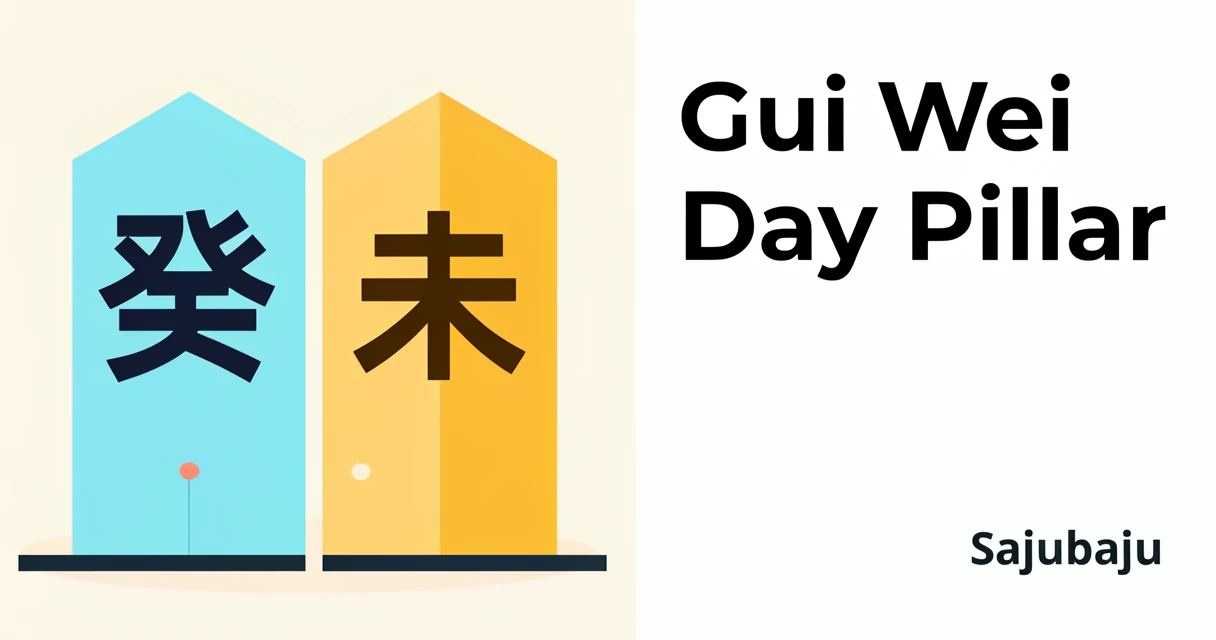
The Gui Wei day pillar (癸未日柱) carries the delicate, intuitive qi of Gui Water together with the steady qi of Wei Earth. Its 12 Life Stage is Mu (墓, "Tomb"), which stands for saving and inner accumulation.
| Trait | Meaning | In practice |
|---|---|---|
| Analysis | Insight | Outstanding at analyzing and understanding a situation in detail |
| Caution | Stability | Judges a situation calmly and handles it steadily |
| Practicality | Follow-through | Solves problems in a realistic, practical way |
| Intuition | Insight | Grasps and anticipates a situation with a delicate sense |
| Sincerity | Responsibility | A sincere attitude that keeps performing the work they take on |
These five traits are the basic tendencies of a Gui Wei person. The delicate intuition of Gui Water meets the steady qi of Wei Earth and shapes a balanced character. They stand out for moving calmly and steadily toward a goal.
Structure of the Gui Wei day pillar
Stems hidden in the day branch 未
The main qi of the day branch is Ji Earth, which is a Seven Killings to the Gui Water Day Master. On top of a bent for intuition, empathy and attentiveness, the energy of the Seven Killings sits close by.
The Heavenly Stem Gui
The Heavenly Stem Gui Water (癸水) stands for the yin qi of Water among the Five Elements and symbolizes a delicate, intuitive energy. Being yin Water, it is a stem that carries a soft, delicate energy.
The core of Gui lies in intuition and delicacy. It holds the qi of gentleness (柔順), so outstanding sensitivity and insight stand out and the ability to analyze in detail is excellent. With outstanding adaptability and flexibility, they grasp a situation accurately and offer suitable responses. They show outstanding ability in planning and analysis, especially in drawing up detailed plans and carrying them out.
Read in a modern way, Gui's traits point to a delicate, analytical quality. They can turn too cautious or indecisive at times, so building a decisive attitude alongside lets Gui's strengths come through better.
The Earthly Branch Wei
Wei Earth (未土) stands for the period among the twelve Earthly Branches in which yang qi matures, and it is a branch with a steady, delicate qi. Its hidden stems are Ding Fire (Indirect Wealth) as the residual qi, Yi Wood (Eating God) as the middle qi and Ji Earth (Seven Killings) as the main qi for a Gui Day Master. Ji Earth, the main qi, controls Gui Water, a relationship of Earth controlling Water, so it brings a careful qi that never lets its tension drop.
Wei's core traits show up in three ways. First, a careful, steady nature gives them the ability to analyze and judge a situation closely. Second, outstanding intuition and analysis make them outstanding at solving problems. Third, a delicate sense and practical wisdom let them handle work efficiently.
When Wei's traits combine with Gui, they form a shape in which analysis and practical ability stand out and lead to steady, lasting results. A careful nature can sometimes slow a decision, so it helps to build decisiveness alongside.
A Seven Killings in the day branch
In Gui Wei the Seven Killings (偏官) is the energy that arises when Ji Earth, the main qi of Wei, controls Gui Water. Ji and Gui share the same polarity, so it is a Seven Killings, and it works as a force that brings tension and stimulus and makes a person steady themselves.
The Seven Killings shows up in three ways. First, in a pressured situation, concentration and problem-solving ability actually come alive. Second, a sense of responsibility and crisis response are strong. Third, the delicacy of Gui and the steadiness of Wei work together and bring practical yet careful ability.
Under this influence, Gui Wei shows to advantage in fields where rules and responsibility are clear. They can be too strict with themselves or keep the tension up for too long, so it helps to build room to rest alongside.
The 12 Life Stages: Mu
Gui Wei falls on the stage of Mu (墓, "Tomb") among the 12 Life Stages, which stands for saving and inner accumulation. Mu stands for a stage of gathering qi and storing it inside, and it is the ninth of the 12 Life Stages, one with a strong power to gather and accumulate inward rather than spread outward.
The Tomb stage shows up in three ways. First, there is a strong tendency to store up experience and knowledge bit by bit. Second, they tend to sort things out and firm them up inside rather than show them outside, so practicing active expression when needed helps. Third, the strength they have built up meets its time and leads to real results, so it helps to focus on preparing steadily.
To use Mu's qi well, they need the decisiveness to bring out at the right moment what they have gathered. Drawing on the delicate intuition of Gui Water while using the steadiness of Wei Earth, and taking on new challenges and growing, is the better way to go.
Gui Wei men and women: same day branch, different readings
Men
- Wife starWealth (Fire)丙丁巳午
- Children starOfficer (Earth)戊己丑辰未戌
Day branch Seven Killings (Officer): Wealth generates Officer.
Women
- Husband starOfficer (Earth)戊己丑辰未戌
- Children starOutput (Wood)甲乙寅卯
Day branch Seven Killings (Officer): Same family: Officer.
Gui Wei men
A Gui Wei man looks quiet and deep in thought, but in front of a job he has to do, he holds out doggedly. He does not show his feelings easily and moves only after watching a situation for a long time. He tries to carry the responsibility he takes on to the end, so people around him trust him with work.
Traits of Gui Wei men
The main qi of the day branch Wei is Ji Earth, a Seven Killings for the Day Master Gui. The Seven Killings is the Officer that controls the Day Master with the same polarity, and it is the power to hold out against pressure that arrives without warning. In the 12 Life Stages it is Mu, and Sajubaju reads it less as a weak place than as a phase of gathering in and storing what has passed.
Inside Wei are Ding (Indirect Wealth), Yi (Eating God) and Ji (Seven Killings). The Indirect Wealth that watches for chances, the Eating God that makes things with its hands and the Seven Killings that bears tension gather in one place. So even if he looks relaxed on the outside, inside he keeps working out how to get it done.
Love and marriage for Gui Wei men
The traditional reading of family relations takes the Wealth star in a man's chart as his wife. For a Gui Day Master, Wealth is Fire: Bing (丙) is the Direct Wealth and Ding (丁) the Indirect Wealth. The Indirect Wealth Ding sits in the residual qi of Wei, so the wife star is tucked inside the spouse palace. The common view reads this shape as one that cherishes the spouse but shows its feelings less on the outside.
The Seven Killings in the main qi is the tension of never looking weak, so he easily shoulders hard things alone and keeps his words few. His partner may feel that silence as distance. If he shares even a word before finishing a hard thing alone, the responsibility of the Seven Killings works to protect them both.
Compatibility for Gui Wei men
Between Day Masters, he is said to feel a strong pull toward a woman with a Wu (戊) Day Master, his stem-combination partner (戊癸合). Going by the wife star, a woman with a Bing (丙) Day Master, the Direct Wealth, is also one that old readings often point to. Between day branches, he bonds easily with someone whose day branch is Wu (午), which forms a Six Harmonies pair with Wei. With someone whose day branch is Chou (丑), directly opposite Wei, the branches clash and stubbornness easily meets stubbornness. A Wu Earth and Gui Water pairing is covered in Wu Earth and Gui Water compatibility, and the ideal type in the Gui Wei ideal type guide.
Gui Wei women
A Gui Wei woman has a stubbornness that does not easily break inside a soft, calm way of speaking. She reads other people's circumstances well, but she never lets go of her own share of responsibility. She tends not to show when she is having a hard time, so those around her sometimes notice what is going on inside late.
Traits of Gui Wei women
A Gui Wei woman has a Seven Killings in the spouse palace. She is strict with herself and holds out to finish the work she takes on even in a high-pressure spot. The Eating God Yi inside Wei adds manual skill and expressiveness, so she tends to show her ability through finished work.
Love and marriage for Gui Wei women
The traditional reading takes the Officer star in a woman's chart as her husband. For a Gui Day Master, the Officer is Earth: Wu (戊) is the Direct Officer and Ji (己) the Seven Killings. The main qi of Wei is the Seven Killings Ji, so the husband star sits right in the middle of the spouse palace. The Indirect Wealth Ding in the residual qi generates that Ji, so the common view reads the Gui Wei woman as one who attentively helps her spouse's work.
The Seven Killings is a star that presses hard on the Day Master, so old readings also said she easily meets a strict or strong-willed spouse. Sajubaju does not use this reading as a verdict on marriage luck. Before the husband, the place where the Seven Killings sits shows up as a tendency to push herself hard.
Compatibility for Gui Wei women
A Gui Wei woman, too, looks first at the stem combination with Wu Earth between Day Masters and the Six Harmonies with Wu (午) between day branches. A man with a Wu Earth Day Master has the Direct Officer, her husband star, as his Day Master and is also her stem-combination partner, so old readings point to him most often. A Chou (丑) day branch clashes with hers and daily habits may differ, so dividing the household chores early helps.
Gui Wei at a glance
12 Life Stages
Tomb
Gui Water on the day branch 未
Void (Kong Wang)
申 酉
The Shen and You slots are empty
Day-pillar stars
None
Checked for White Tiger and Kuigang
The six day pillars of Gui Water
Strengths and weaknesses
Gui Wei is the combination of the stem Gui Water (癸水) and the branch Wei Earth (未土), a pillar marked by delicate intuition and steady execution. These traits can be both a strength and a task to work on in personal growth and social achievement.
Strengths
- Analysis: outstanding intuition and delicate analysis let them grasp a situation accurately.
- Stability: a calm, careful attitude lets them handle work steadily.
- Practicality: a realistic, practical approach produces efficient results.
- Care: detailed planning and meticulous execution make highly finished results.
Weaknesses and how to balance them
- Indecision: too much caution can slow decisions.
- Passivity: in pursuing stability, they may hesitate over new challenges.
- Perfectionism: fixating on details can slow the progress of work.
- Rigidity: sticking to existing ways can make it hard to adapt to change.
To bring out their potential fully, a Gui Wei person needs to balance delicate analysis with steady execution. Making up for excess caution and passivity and building decisiveness lets delicacy and stability really come through.
In compatibility, the day branch Wei (未) forms a Six Harmonies pair with Wu (午), clashes with Chou (丑) and is a Wonjin (怨嗔, a Korean pairing read as mutual resentment) with Zi (子). Among stems, a Wu Earth Day Master forms the stem combination 戊癸合. The Void (空亡) branches are Shen (申) and You (酉).
Best careers for Gui Wei
Gui Wei combines delicate analytical ability with steady execution. The main career fields are these:
- Professional work: delicate analysis and practical ability let them stand out in a specialist field.
- Research and analysis: outstanding intuition and analytical ability carry out in-depth research.
- Practical work and management: systematic, steady work takes charge of an organization's practical affairs.
Their strengths at work:
- Analysis: improving the finish of work through close observation and accurate analysis
- Practical ability: building trust through systematic, steady work
- Caution: achieving results through careful planning and accurate execution
To manage a career well, they should make up for excess caution and an indecisive streak and build a decisive attitude. Balancing delicacy and execution, they can grow into someone with both expertise and practical ability.
Gui Wei in brief
· A Yin Water Day Master sitting on Wei (未), a Earth branch.
· The main qi of the day branch is a Seven Killings to the Day Master. A partner who brings tension and stimulation.
· Strength keywords: intuition, empathy and attentiveness.
Sajubaju · Day pillars
Frequently asked questions
What are the main traits of the Gui Wei day pillar?
Gui Wei (癸未日柱) pairs the stem Gui Water (癸水) with the branch Wei Earth (未土). On the basis of delicate intuition and steadiness it has a careful, analytical tendency and is strong at detailed planning and practical work. Ji, the main qi of the day branch, is a Seven Killings, so there is also a force that steadies itself within tension.
What careers suit Gui Wei?
With a delicate sense and practical wisdom, Gui Wei tends to handle work efficiently. They stand out in planning and analysis and in drawing up detailed plans and carrying them out. Under the influence of the Seven Killings, they also tend to do well in work where rules and responsibility are clear.
What are the strengths and weaknesses of Gui Wei?
The strengths are analysis, caution, practicality, intuition and sincerity. Close analysis and steady problem-solving stand out. On the other hand, they can become too cautious or indecisive, so building decisiveness alongside helps.
What does the Seven Killings (偏官) mean for Gui Wei?
Ji, the main qi of Wei, controls Gui Water and the two share the same polarity, so it becomes a Seven Killings. It is an energy that brings tension and stimulus, so a Gui Wei person tends to see concentration and a sense of responsibility come alive in pressured situations.
Who is a good match for Gui Wei?
Among stems, a Wu Earth Day Master forms the stem combination 戊癸合 with Gui. Among branches, Wu (午) forms a Six Harmonies pair with the day branch Wei. In contrast, Chou (丑) clashes with Wei and Zi (子) is a Wonjin (怨嗔, a Korean pairing read as mutual resentment), so it may take more time to adjust to each other.
More articles
- Bing Zi (丙子) Day Pillar: Personality, Love & Career
- Ding Chou (丁丑) Day Pillar: Personality, Love & Career
- Jia Xu (甲戌) Day Pillar: Personality, Love & Career
- Wu Yin (戊寅) Day Pillar: Personality, Love & Career
- Yi Hai (乙亥) Day Pillar: Personality, Love & Career
- Geng Chen (庚辰) Day Pillar: Personality, Love & Career
- Ji Mao (己卯) Day Pillar: Personality, Love & Career
- Ren Wu (壬午) Day Pillar: Personality, Love & Career